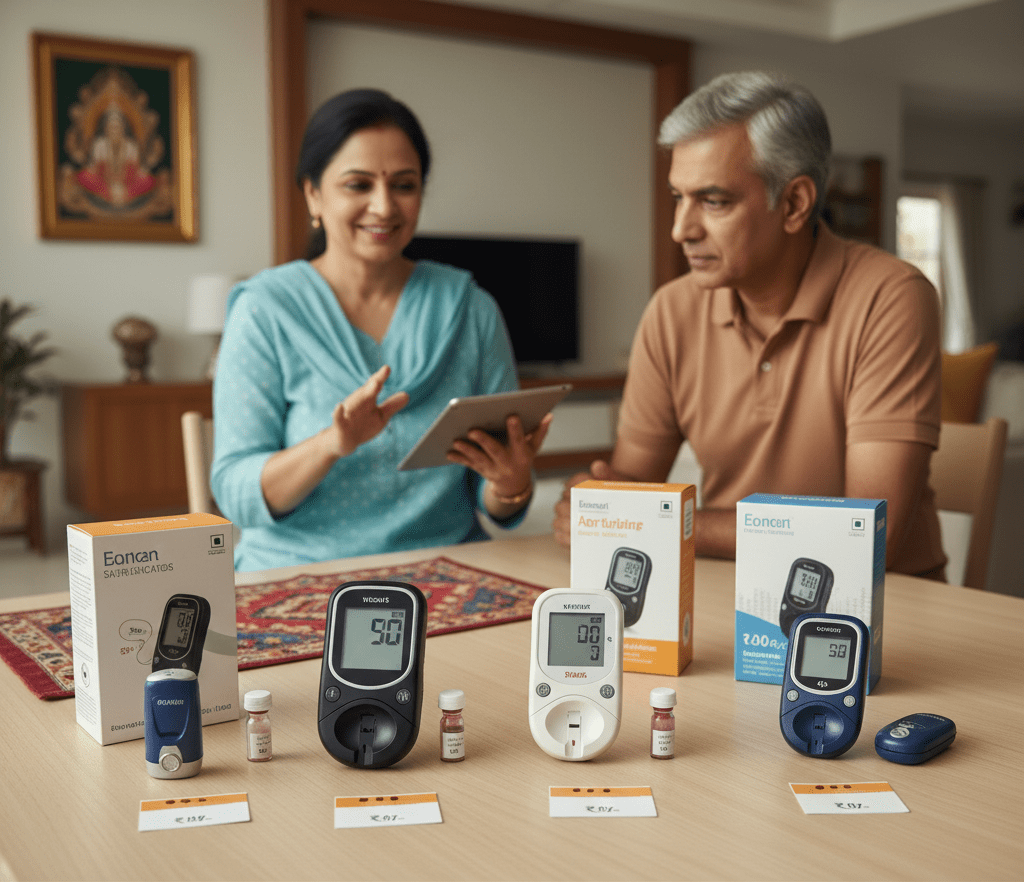
Diabetes is now a part of everyday conversation in most Indian families — from chai-time talks to diet plans. Whether it’s your parents checking sugar after meals or you tracking fitness goals, a glucometer at home has become as essential as a BP machine.
But with so many brands and models in the market, how do you know which one to trust for accuracy and value?
This guide simplifies it for you — explaining how glucometers work, what to look for, how to use them right, and what price range fits your needs.
(Disclaimer: Glucometer readings are for self-monitoring only. Always confirm abnormal readings with lab tests and consult your doctor for medication changes.)
Why every Indian household should have a glucometer
India is called the “diabetes capital of the world” — and early detection is the best prevention.
Home sugar monitoring helps you:
- Track blood glucose patterns between doctor visits.
- Know how food, stress, or medicine affects your sugar.
- Avoid sudden lows or highs.
- Stay accountable and motivated for lifestyle changes.
Whether you’re managing diabetes, monitoring after gestational diabetes, or simply staying cautious, a small glucometer can give peace of mind daily.
How a glucometer works
A glucometer measures the amount of glucose (sugar) in a drop of blood — usually from your fingertip.
It works like this:
- Insert a test strip into the device.
- Prick your fingertip with a lancet (tiny needle).
- Place the blood drop on the strip.
- The device analyses it using an enzyme reaction and displays the reading (mg/dL) within seconds.
Most readings are reliable if the meter and strips are properly stored and calibrated.
When to check blood sugar at home
Your doctor may suggest checking at these times:
- Fasting: Early morning before eating or drinking.
- Postprandial: 2 hours after meals.
- Random: Any time you feel dizzy, thirsty, or weak.
- Before bed: For insulin users.
Frequent checks help tailor diet and medicines accurately.
Types of Glucometers
1. Basic Glucometers
- Compact and easy to use.
- Shows sugar level instantly.
- Good for routine home users.
2. Smart Glucometers (Bluetooth / App Sync)
- Connect to your phone for trend tracking and graph reports.
- Helpful for younger or tech-savvy users.
3. Continuous Glucose Monitors (CGM)
- Advanced systems that track sugar every few minutes via sensors on the skin.
- More expensive, used for special medical situations.
For most Indian families, a simple digital glucometer with affordable strips is more than enough.
Remember: Even if your baby doesn’t respond right away, your words are shaping how they learn and bond with you.

What to Look for When Buying a Glucometer
- Accuracy and consistency
- Choose meters approved by ISO 15197:2013 standards for accuracy.
- Accuracy depends on both the device and the quality of strips.
- Choose meters approved by ISO 15197:2013 standards for accuracy.
- Cost & availability of strips
- The device is a one-time buy, but strips are the long-term cost.
- Pick a model with widely available and affordable strips.
- The device is a one-time buy, but strips are the long-term cost.
- Sample size and speed
- Smaller blood sample (0.5–1 µL) = less pain.
- Reading time should be under 10 seconds.
- Smaller blood sample (0.5–1 µL) = less pain.
- Memory and App support
- Stores 100–500 readings — useful for comparing trends.
- Some sync with mobile apps or cloud reports for doctor sharing.
- Stores 100–500 readings — useful for comparing trends.
- Power source & display
- Battery-operated, easy to replace (AAA or button cells).
- Clear display helps elders read easily.
- Battery-operated, easy to replace (AAA or button cells).
- Lancet comfort
- Adjustable lancet depth ensures less finger pain.
- Adjustable lancet depth ensures less finger pain.
- Warranty & Customer service
- 1–3 years warranty with service available in your city.
- 1–3 years warranty with service available in your city.
How to use a glucometer correctly
- Wash hands and dry them completely.
- Insert a new test strip into the meter.
- Prick the side of your fingertip using the lancet.
- Touch the strip to the drop of blood.
- Wait for the reading to display.
- Record or sync results for tracking.
Avoid: Using wet fingers, expired strips, or storing strips in humid places.
Average blood sugar range (mg/dL)
Condition | Fasting | 2 Hours After Meals |
Normal | 70–99 | <140 |
Prediabetes | 100–125 | 140–199 |
Diabetes | ≥126 | ≥200 |
Consult your doctor if readings are frequently outside the target range.
Typical price range in India
Category | Features | Approx Price (₹) |
Basic Glucometer | Digital display, manual record | ₹700 – ₹1,200 |
Mid-Range Smart Meter | Memory + Bluetooth / App | ₹1,200 – ₹2,500 |
Continuous Glucose Monitor (CGM) | Wearable sensor-based | ₹3,000 – ₹8,000+ (per sensor set) |
Test strips: Usually ₹700–₹1,000 for a pack of 50.
How to keep readings accurate
- Store strips in a cool, dry place with the lid tightly closed.
- Check expiry before use.
- Don’t reuse strips or share meters.
- Calibrate if your model allows it.
- Compare with lab glucose test once every few months for accuracy check.
Common mistakes to avoid
- Taking readings right after eating sweets or tea.
- Not washing hands — food residue affects results.
- Storing strips near the stove or in the fridge.
- Skipping calibration for older models.
Maintenance and safety tips
- Keep the glucometer clean and dry.
- Use each lancet only once to avoid infection.
- Dispose of used strips and lancets safely in a closed container.
- Keep a small logbook for tracking, especially if multiple family members use it.
Final takeaway for Indian families
A glucometer at home isn’t just for people with diabetes — it’s for every Indian family that values prevention.
If you:
- Choose a reliable, ISO-certified glucometer,
- Use fresh strips and clean hands for each reading,
- Record your numbers regularly, and
- Share them with your doctor —
you’ll be taking smart, simple steps to keep sugar levels — and stress levels — under control.
Because managing diabetes at home isn’t about fear — it’s about awareness, routine, and care that keeps your loved ones healthy for the long run.
Faster Care Tip: Skip the pharmacy rush! Order your baby care essentials and medicines online — it’s fast, safe, and delivered right to your doorstep. A few clicks today can save you a last-minute pharmacy run tomorrow.
Last medically reviewed on September 18, 2025 by Dr Tanvi Modi, MBBS, MD, DNB (Paediatrics)
Dr Tanvi Modi,
MBBS,
MD, DNB (Paediatrics)