
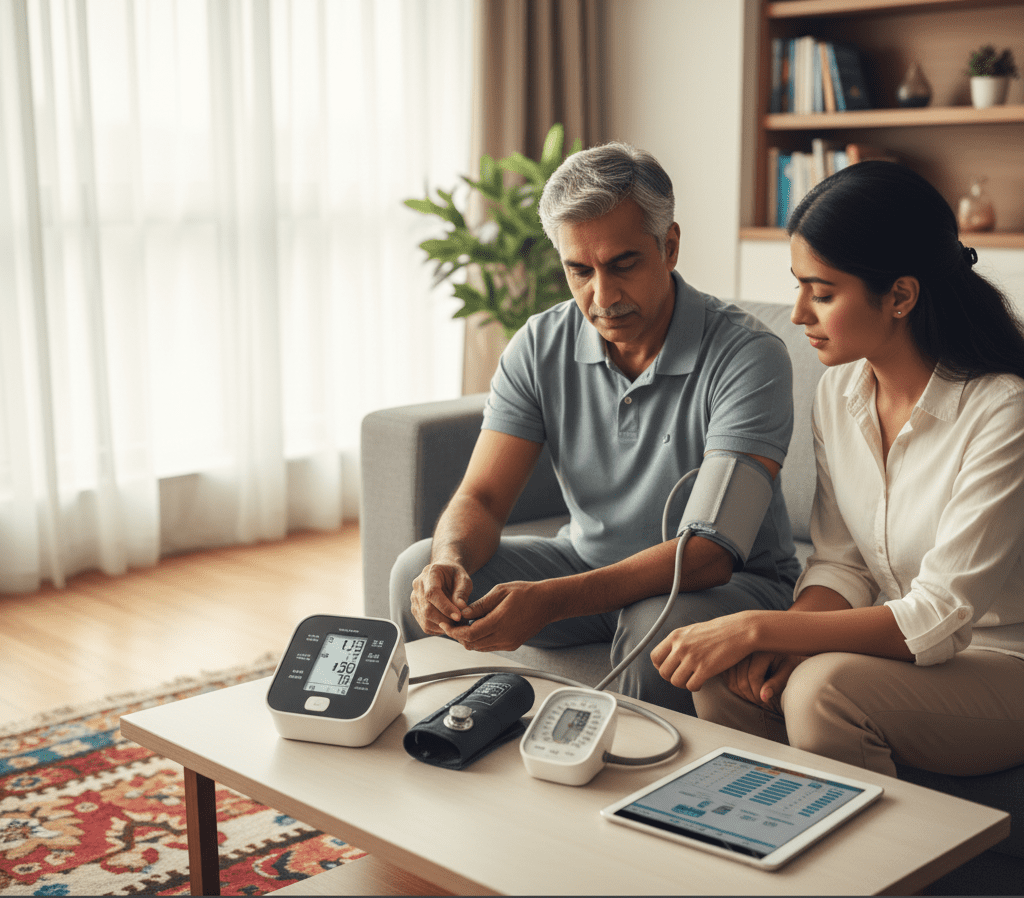
High blood pressure — or “BP badh gaya hai” as we often say — is now one of India’s most common lifestyle problems. From office stress to midnight snacks, it silently affects millions. The good news: keeping a BP monitor at home makes it easy to track and manage before it becomes serious.
But which type should you buy? What numbers really matter? And are all machines accurate? Let’s break it down simply — just like your family doctor would explain.
(Disclaimer: Home BP monitors are for regular tracking, not for self-diagnosis or changing medication doses. Always discuss readings with your doctor.)
Why Every Indian Family Should Have a BP Monitor
- Hypertension (high BP) often has no symptoms — that’s why it’s called the “silent killer.”
- Regular monitoring helps spot rising trends early.
- Home readings reduce stress compared to clinic readings (“white coat effect”).
- It’s useful for people with:
- Diabetes or thyroid issues
- Heart disease
- Pregnancy-induced BP changes
- Family history of hypertension
Consistent home tracking helps doctors adjust medicines correctly and prevent complications like stroke or kidney disease.
How a BP Machine Works
A digital BP monitor measures the pressure of blood against artery walls when your heart beats and rests.
It shows two readings:
- Systolic (upper number): Pressure when the heart beats.
- Diastolic (lower number): Pressure when the heart relaxes.
Example: 120/80 mmHg (read as “120 over 80”) is normal for adults.
Types of BP Monitors in India
1. Digital Upper Arm Monitors
- Most accurate for home use.
- The cuff wraps around the upper arm and inflates automatically.
- Results show on a clear display.
- Many models store readings for multiple users.
- Ideal for: Families, elderly users, and those under regular BP monitoring.
2. Wrist BP Monitors
- Compact and portable; cuff fits around the wrist.
- Convenient for travel, but accuracy depends on correct posture.
- Ideal for: Occasional users or those who find arm cuffs uncomfortable.
3. Manual BP Monitors (Mercury or Aneroid Type)
- Used by doctors and trained professionals.
- Requires a stethoscope and skill to read.
- Not recommended for untrained home users.
What to Look For Before Buying a BP Machine
- Accuracy & Validation
Look for devices that are clinically validated by organizations like WHO, ESH (European Society of Hypertension), or AAMI. - Cuff Size
Choose the right arm circumference — standard (22–32 cm) or large (32–42 cm). Too tight or too loose gives wrong readings. - Display Clarity
Large digital display with backlight helps elders read numbers easily. - Memory & App Connectivity
Good for tracking progress or sharing reports with doctors. Many models store 60–100 readings. - Power Option
Prefer machines with both battery and adapter options for flexibility. - Irregular Heartbeat Indicator
Helpful feature to alert if heartbeat patterns are uneven. - Warranty & Service
Choose models with at least 2–3 years warranty and local service centres.
How to Measure BP Correctly at Home
- Sit quietly for 5 minutes before checking.
- Keep your arm supported at heart level.
- Don’t talk or move during measurement.
- Take two readings, 1–2 minutes apart, and record the average.
- Measure at the same time daily (morning or evening).
Avoid checking immediately after tea, coffee, smoking, or exercise.
Understanding Your Readings
BP Category | Systolic (mmHg) | Diastolic (mmHg) |
Normal | <120 | <80 |
Elevated | 120–129 | <80 |
Hypertension (Stage 1) | 130–139 | 80–89 |
Hypertension (Stage 2) | ≥140 | ≥90 |
Seek medical care immediately | ≥180 | ≥120 |
If readings stay high for several days, consult your doctor — don’t increase or skip medicines yourself.
Typical Price Range in India
Type | Suitable For | Approx Price (₹) |
Digital Arm BP Monitor | Most accurate, family use | ₹1,200 – ₹3,000 |
Wrist BP Monitor | Travel-friendly, quick check | ₹1,000 – ₹2,500 |
Manual Aneroid Set | Professional use only | ₹1,500 – ₹3,000 |
A mid-range digital upper-arm BP monitor usually balances accuracy, ease, and reliability for Indian households.
Common Mistakes to Avoid
- Checking BP right after meals or stress.
- Cuff placed over clothes.
- Using wrong cuff size.
- Not recording readings properly.
- Comparing different machine readings without calibration.
Tip: Take your home BP machine to your doctor once a year to verify accuracy.
Maintenance & Care Tips
- Store in a dry place, away from moisture.
- Replace batteries when the display dims.
- Clean the cuff with a damp cloth (no soap or alcohol).
- Don’t wrap the cuff tightly when storing — it shortens its life.
Faster Care Tip: Skip the pharmacy rush! Order your essentials medicines online — it’s fast, safe, and delivered right to your doorstep. A few clicks today can save you a last-minute pharmacy run tomorrow.
Final Takeaway for Indian Families
A BP monitor at home is not luxury — it’s a basic health essential today.
If you:
- Choose a validated digital upper-arm machine,
- Measure correctly at the same time daily,
- Keep a log of readings for your doctor, and
- Pair it with healthy habits like less salt, more walks, and better sleep —
you’ll take real control of your heart health.
Because in Indian homes, prevention isn’t just better than cure — it’s peace of mind at your fingertips.
Last medically reviewed on September 25, 2025 by Dr Tanvi Modi, MBBS, MD, DNB (Paediatrics)
Dr Tanvi Modi,
MBBS,
MD, DNB (Paediatrics)